"Everything is as it should be."

                                                                                  - Benjamin Purcell Morris


© all material on this website is written by Michael McCaffrey, is copyrighted, and may not be republished without consent

Follow me on Twitter: Michael McCaffrey @MPMActingCo

Caught Stealing: A Review – A Criminally Awful Movie

****THIS IS A SPOILER FREE REVIEW!! THIS REVIEW CONTAINS ZERO SPOILERS!!****

My Rating: 1 out of 5 stars

My Recommendation: SKIP IT. An instantly forgettable and irritatingly moronic movie that when it isn’t being incoherent is idiotic.

Caught Stealing, directed by Darren Aronofsky and starring Austin Butler, is a “black comedy crime thriller” that follows the travails of Hank (Butler), a former baseball player turned alcoholic bartender who unwittingly gets mixed up with a bevy of New York criminal gangs. 

I vividly remember twenty-five years ago seeing director Darren Aronofsky’s film Requiem for a Dream (2000) - a gritty and cinematic examination of addiction, and immediately thinking, “this guy is gonna be something!”

A quarter of a century later I have been proven absolutely correct in my assessment, Aronofsky has become “something”, but unfortunately the “something” he has become is the feckless hack who made Caught Stealing, one of the more abysmal and idiotic films of the year.

It didn’t have to be this way. Aronofsky, a graduate of the esteemed AFI Conservatory, started out making ambitious arthouse fare like PI (1998), and then graduated to ambitious arthouse projects with some crossover mainstream appeal, such as the previously mentioned Requiem for a Dream, The Fountain (2006), The Wrestler (2008) and Black Swan (2010).

All of these movies were very good…but never quite touched upon greatness…but what they did most of all was showcase Aronofsky’s potential. They left cinephile/film bros like me with the feeling that Aronofsky was going to make the leap one day and become THE GUY.

In 2014 Aronofsky attempted to make that leap to even more mainstream success than he had with The Wrestler and Black Swan, with the big budget movie Noah (2014) starring Russell Crowe – based on the biblical tale.

Noah was a very moderate box office success (it made $359 million - essentially breaking even due to its large budget), but it was a horrendously awful film – just utter garbage from start to finish.

It was at this point that the Aronofsky film bro bubble burst like the deluge that flooded the earth in Noah.

Following Noah, Aronofsky made Mother! (2019), a very ambitious, dare I say experimental, arthouse film starring Jennifer Lawrence (at the height of her powers), and it was universally panned and flopped at the box office. The wheels seemed to be off the wagon at that point.

Aronofsky’s most recent film was The Whale (2022) a truly insipid piece of dramatic detritus that won Brendan Fraser a Best Actor Oscar (yes, that really happened despite all of us forgetting about it…or trying to forget about it).

Despite Aronofsky’s failings on Noah, Mother! and The Whale, at least he was trying…failing but trying. With Caught Stealing, it feels as if the wheels aren’t just off the Aronofsky wagon, but the wheelless wagon is overturned in a ditch and Aronofsky is next to it curled in fetal position weeping uncontrollably in a pile of horse manure.

For such a promising talent like Aronofsky to make such a dead-eyed, instantly forgettable, truly idiotic piece of trash like Caught Stealing isn’t just disappointing, it is frightening. I mean, if he could fall so low as to make this movie, how low could the rest of us fall in our own lives? Yes, I am sure Aronofsky was paid more to make this movie than I’ve ever made in my entire life…but you get my point.

Caught Stealing is lazy and stupid and useless. It is a “black comedy” that is allergic to being funny. It is a crime thriller devoid of thrills.

The script, written by Charlie Huston - based upon his book of the same name, is incoherent and moronic. There are all sorts of incomprehensible plot twists and a cornucopia of caricatures in place of characters, and none of it makes sense or even remotely captivates or compels.

The performances all feel like something out of a sixth-grade talent show.

Austin Butler is supposed to be the next big thing. I was believing the hype on young Austin, as I thought he was good in Once Upon a Time in Hollywood, Elvis, and Dune II. But let me tell you…after seeing Butler’s star turn in Caught Stealing I have come to realize he ain’t no burgeoning movie star. He might be a successful supporting actor type guy, but he can’t carry a movie to save his life.

Butler is brutally bad as Hank. He is obviously hampered by the trite and inane script, but Butler does himself no favors with a lifeless and mannered performance. He is so devoid of charisma and screen presence they would’ve been better served casting an inanimate carbon rod in the role instead.

Other once promising actors find themselves wallowing in the same shit script as Butler…as Regina King, Zoe Kravitz, Matt Smith, Liev Schreiber, Griffin Dune, Carol Kane and my old friend Vincent D’Onofrio all turn in gruesomely amateurish performances that sully their reputations.

Caught Stealing bombed at the box office, making $32 million on a $65 million budget, and is now streaming on Netflix, which is where I saw it. The film runs an hour and forty-seven minutes, and is right at home among the usual mindless Netflix slop. This is the type of movie you watch while scrolling on your phone or while having sex with your girlfriend on the couch after your parents go to bed early.

I wish Darren Aronofsky was good. I wanted Darren Aronofsky to be great. But Darren Aronofsky isn’t good and he isn’t great…he’s the guy who made the thoughtless, mindless, worthless Caught Stealing. How disheartening.

©2025
Spotlight : A Review

****THIS REVIEW CONATINS ZERO SPOILERS!!! THIS IS A SPOILER FREE REVIEW!!!****

MY RATING : SEE IT IN THE THEATRE!!

Spotlight, directed by Tom McCarthy and written by McCarthy and Josh Singer, is the true story of a team of reporters from the Boston Globe's Spotlight team, who investigate and report on child sex abuse by Catholic priests in the Boston Diocese. The film stars Michael Keaton, Mark Ruffalo, Rachel McAdams, Stanley Tucci, John Slattery and Liev Schrieber.

Spotlight is one of the very best films of the year. It is a tense drama, exquisitely acted by a sterling cast, deftly directed and intricately edited. Spotlight is the type of film that seems like it could have been made during cinema's golden age in the 1970's. It feels like a distant cousin of that decades All the President's Men, another story of journalism and hard-driving reporters investigating a scandal deep at the heart of a thought to be untouchable power. Interestingly enough, in Spotlight, John Slattery plays Boston Globe journalist and editor Ben Bradlee Jr., the son of famed Washington Post Executive Editor Ben Bradlee, one of the key players at the Post during their Watergate reporting, who was played by Jason Robards in All the President's Men.

Even though Spotlight is set in the late 1990's and early 2000's, it is really an insightful period piece about the last days of the relevancy of newspapers, and of the dying craft of investigative journalism. The film pays homage to the last generation of journalists who will have had the opportunity to work full-time doing investigative reporting for a newspaper. Corporatism and the internet have devastated the newspaper industry, and Spotlight shows us that industry's last gasp, and what we are missing now that it is, for all intents and purposes, dead.

Spotlight is also about the scourge of institutional blindness and the insidiousness of silence in the face of that blindness. The willful institutional blindness of the church, the press, the courts and law enforcement, and of the people of the city of Boston is on full display in the film. At its heart, Spotlight is really an indictment of the city and the people of Boston. Boston is one of the most parochial places you could ever imagine. For a place filled with legendary institutions of higher learning, it is remarkably narrow-minded and short-sighted. As the film shows us, the suffocating claustrophobia, knee-jerk myopia and the vicious parochialism of Boston created a toxic brew of dysfunction, arrogance and deference in which predatory priests and the Church hierarchy thrived. Only an outsider could break the spell of Boston's willful blindness, and in Spotlight that role is played by Liev Schreiber as Marty Baron, a Jewish editor from Miami who is new to the city and the Globe, and not beholden to the Church. Baron is the one who instigates the Spotlight team into investigating the church and pushes them to dig deeper and reach higher up the hierarchy in their work.

When the story of Spotlight ends, and the indictment of Boston is complete, a very long list of other cities and town scrolls across the screen. These cities and towns are places where other Catholic sex abuse scandals have been uncovered, and the viewer gets the dawning realization that Spotlight isn't an indictment against the city and people of Boston, it is an indictment against all of us, no matter where we live. We are all guilty of the same blindness and cowardice, to one degree or another, on display in Spotlight.

Director Tom McCarthy and his editors do a spectacular job deftly maneuvering the viewer through the morass of the allegations and the cover up at the heart of the film. He keeps a solid and steady dramatic pace, never letting the story lose steam or the viewer lose interest. McCarthy shows a great skill in pacing and tempo throughout the film. Spotlight is littered with detailed little gems which frame and shape each scene and propel the story through the entirety of the film. McCarthy is an actor himself, and his understanding of acting is on full display in Spotlight. He keeps the scenes tight and the actors loose. McCarthy directs the drama to be  vibrant, but never pushes the pace too hard that we lose the subtlety, specificity and humanity at the heart of each of the performances.

The acting on display in the film is exquisite across the board. Even the small, local hires, playing abuse victims and local residents, hit it out of the park. This is a top-notch, professionally acted film from top to bottom. Michael Keaton, Mark Ruffalo, Rachel McAdams and Brian D'arcy James play the Spotlight reporters perfectly. They bring a tangible sense of purpose and vivd detail to their work that drives each scene and ultimately the narrative of the entire film.

It is great to see Michael Keaton follow up his great artistic success in last years Birdman, with his solid work in Spotlight. Keaton is pitch-perfect as Walter "Robby" Robertson, a native son of Boston and well-respected journalist. I hope Keaton continues to make these kinds of choices in the projects that he chooses as he is such an asset to any film where he can bring his skill and experience to bear.

McAdams does the best work of her career as reporter Sacha Pfieffer.  McAdams is as grounded and genuine as she has ever been on screen. She displays a humanity and a compelling internal life that is both steady and captivating.

Mark Ruffalo follows up his terrific work in last years otherwise disappointing Foxcatcher, with a dynamic performance as reporter Michael Rezendes. Ruffalo brings a magnetic power and a tangible wound to the role that is mesmerizing. Ruffalo has been on a roll lately with great work and Spotlight is some of his best.

Both Liev Schreiber and Stanley Tucci have smaller roles but they do spectacular work. Both men are actors of extraordinary craft and talent, and they both bring all of their skills to bear in Spotlight. Without Schrieber and Tucci's multi-dimensional portrayals, the film would have suffered greatly.

Spotlight is the type of superbly crafted film of which I wish Hollywood would make more. Spotlight, The Big Short, which is another great film from this year, and 12 Years a Slave from 2013, all had minuscule budgets around $20 million and all of them at least more than doubled their budgets in profits. Instead of spending $100 or $200 million to make a monstrosity like The Avengers or some action piece of crap, why not take that money and make five or ten Spotlights, or The BIg Shorts or 12 Years a Slave? Those three films combined cost $60 million to make and have grossed $363 million. With moderate budgets like that, there is less risk and higher reward, as opposed to a $200 million film, which will nearly double its budget on marketing and then need to make a billion dollars just to be considered a success. Spotlight shows that good and great films can be made relatively inexpensively using just the skill, craft and talent of the people involved. I wish for all of our sakes that Hollywood would learn that lesson, but I have a sneaking suspicion that they won't. Regardless of the state of the film industry, Spotlight is proof that there are still artists out there capable of making high quality, smart films. 

In conclusion, Spotlight is one of my favorite films of the year. It teaches us hard lessons about our own cultural blindness and the price that the most vulnerable among us pay for it. It also shows us a time not long ago, when the press could, on its better days, hold those in power accountable. Those days are long gone, and Spotlight reveals to us that our culture is lesser for the loss of true investigative journalism. Spotlight is well worth your time, money and effort to go see it in the theaters. I strongly encourage you to do so. 

©2016


****WARNING, THIS FOLLOWING SECTION CONTAINS SPOILERS!! THIS IS YOUR OFFICIAL SPOILER ALERT****

FROM THE KONSPIRACY KORNER!!

(This section is written by my lifelong friend and our resident conspiracist, Prof. Rev. Dr. Steve Keithans a.k.a The Mayor of Westfield. The good Professor Reverend Doctor Keithans views may or may not be the same as my own, but regardless, I am happy to share them here with you now.)

The strangest thing…when speaking with my good brother Michael McCaffrey about the film Spotlight, one of the great elements that we both noticed about the film was how fantastically well paced it is. But to my eyes there was one small hiccup which stuck out to me like a sore thumb. Films have a visual style, rhythm and pace to them. Shots are consistently framed and lit in a certain style and held for a certain length creating an unconscious rhythm for the viewer of a film. Each shot informs the shot that follows it and is informed by the one that preceded it. Spotlight quickly establishes its visual rhythm and sticks with it through the entire film…except for one…single...shot.

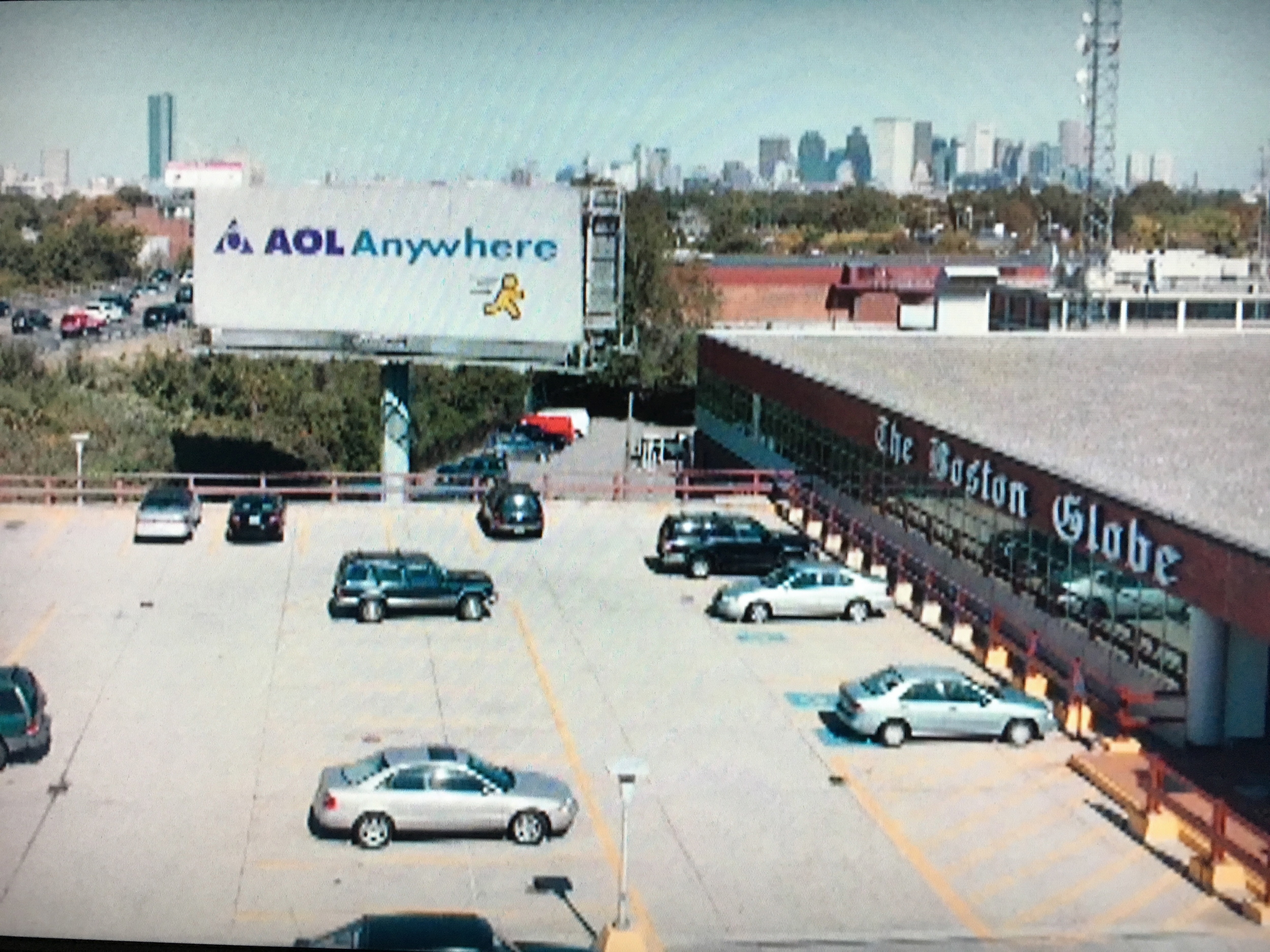
The shot in question takes place at exactly 1 hour 23 minutes and 22 seconds of the film. The shot is of the Boston Globe parking lot as editor Mark Baron (Liev Schreiber) arrives to the office. It is a wide shot, one which we have not seen yet, nor will we see it again. We have seen this same parking lot before but only in close ups and two shots of the actors in their cars. In this shot, from a high angle wide shot, we see Baron pull his car in to the parking lot. Looming over the parking lot, and dominating the shot, is a big "AOL Anywhere" billboard and the background is the skyline of Boston. Here is a screen capture of the shot.

It is an odd shot in the context of the visual style and rhythm of the film and it is jarring to the unconscious of the viewer because it breaks that rhythm. It is pretty striking that the one shot that is out of rhythm with the entire film is that of an AOL Anywhere billboard which happens to have a giant pyramid with an all seeing eye in it. What makes the shot all the more jarring is the context of where it shows up in the film. The scene directly following this shot shows Mark Baron entering the Boston Globe office, in the foreground a group of people are gathered around a television watching breaking news. The breaking news is the 9-11 attack. Baron stops in front of the television long enough to see a jumbo jet crash into the World Trade Center. 

When I first saw the film I felt uneasy with the parking lot shot, but didn't really give it much thought. The sensation was one of slight discomfort, something just seemed off, nothing more. It was more subconscious than anything and it barely registered in my conscious mind except to say…"hmmm…that feels…off".

Upon my second viewing of the film, I was more consciously jarred by the visual anomaly, and I wondered if this was just a very unsubtle case of AOL product placement.  

Then I thought, well, maybe the director is trying to symbolically say that newspapers in general, and the Boston Globe in particular, don't know what is coming at them, the black swan theory if you will…that they are blind to their own on-coming demise in the form of AOL (the internet), much like the U.S. was blind to the 9-11 attacks. 

Then I wondered if maybe this shot has a deeper meaning that the director was not even conscious of, or maybe he was…who knows, right? Maybe the all seeing eye highlighted in that shot is symbolic of one of the shadowy "secret societies" that are known to use child sex abuse rituals when they practice their dark art. Or maybe it is symbolic of the all seeing eye of "the powers that be" in the military-intelligence-surveillance industrial complex who were either complicit or entirely behind the 9-11 attacks in order to increase their power and control by creating a "new Pearl Harbor". Or maybe those two groups, the child sex abuse ritual people, and the military-intelligence-surveillience industrial complex people are cross pollinated and are actually one in the same and this shot shows us a brief glimpse of their vast power and control…the billboard does say "AOL Everywhere" after all.

Then I wondered if maybe this shot was a secret warning from an insider of one of these groups, alerting anyone with the eyes to see that this nefarious, shadowy group was behind both the sex abuse in the Catholic church, and 9-11 and most everything we see in the media (once again…"Everywhere"). And then I wondered if this shot was indicating that another 9-11 was coming, this time aimed at Boston.

And then I wondered why my head hurt so much, and then I realized that my tinfoil hat was on way too tight. Sadly, after I removed the tinfoil hat from my head, the aching still remained…and even more unsettlingly, so did the anomaly of that shot and the all seeing eye in the pyramid looming over the city of Boston, and glaring right at me…and seeing right through me…knowing and controlling…"EVERYTHING".

©2016